Itemized Versus Flat Estimates for Land Work
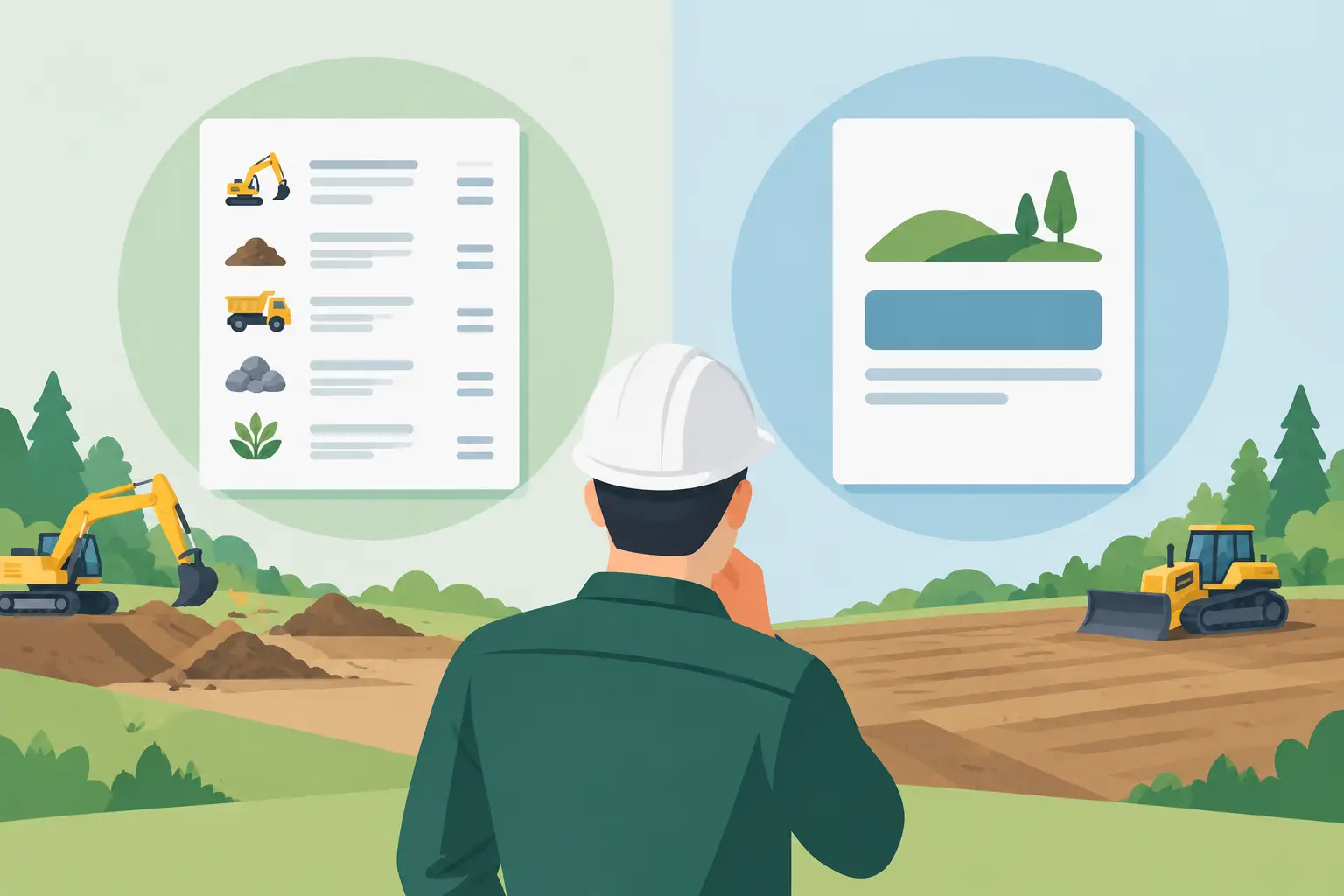
A property can look like a simple clearing job from the road, then reveal buried wire, washouts, old fence, dense cedar, or a soft creek crossing once work begins. That is why itemized versus flat estimates is more than a pricing question. It affects what gets done, what happens when site conditions change, and whether you can compare two land-service proposals fairly.
For forestry mulching, bush hogging, tractor work, storm cleanup, and land clearing, a good estimate should make the work understandable before equipment rolls onto the property. The best format depends on the project. What matters most is a clear scope, honest assumptions, and a contractor willing to explain the plan.
What Is an Itemized Estimate?
An itemized estimate separates a project into defined services, quantities, or cost categories. Instead of seeing one total for “land clearing,” you may see individual lines for site access, forestry mulching, brush hogging, selective tree or brush removal, debris handling, haul-off, grading, or travel and mobilization.
This approach is especially useful when a property needs more than one type of work. A homeowner may want the back acreage mulched, a driveway corridor opened, a fence line cleaned, and a small area prepared for a shed. Those tasks use different equipment, take different amounts of time, and may carry different site risks. Breaking them out helps everyone see where the budget is going.
An itemized estimate also gives the owner more control over priorities. If the full project exceeds the budget, you can decide to start with access roads and the future building area, then return to the remaining acreage later. The work plan stays practical instead of becoming an all-or-nothing decision.
When itemized pricing makes sense
Itemized pricing is often the better choice when the work has several distinct phases, when the property has uncertain conditions, or when the owner wants options. It can be a strong fit for acreage improvements, construction-site preparation, pasture restoration, storm-damage cleanup, and properties where some vegetation should stay while other areas need to be cleared.
It is also helpful when multiple decision-makers are involved. A ranch manager, property owner, builder, or family member can look at the same proposal and understand what is included. That level of detail reduces confusion later.
The trade-off is that itemized estimates can look more complicated at first. They require a careful site assessment and a little more conversation before the job starts. That is usually time well spent when the work involves valuable land, structures, utilities, drainage, fences, or grazing areas.
What Is a Flat Estimate?
A flat estimate gives one set price for a clearly defined job. For example, a contractor may quote a single total to bush hog an open five-acre field, mulch a marked trail system, or clear a specified overgrown lot to an agreed finish level.
Flat pricing is simple and easy to budget. If the scope is well defined and site conditions are visible, the owner knows the expected project cost without sorting through separate line items. For straightforward work, that simplicity is a real advantage.
A flat estimate is not automatically less detailed or less professional. The key is whether the written scope explains what the flat price covers. A solid flat proposal should still identify the work area, type of vegetation, expected finish, access conditions, disposal expectations, and any limits on the work.
When a flat price works well
Flat estimates are often a good fit for routine maintenance and predictable jobs. Think of seasonal mowing on a known property, brush hogging a field that has been maintained before, or mulching a measured area with uniform brush and dependable access.
They work best when there are few unknowns. If the operator can inspect the site, confirm the boundaries, see the vegetation, and determine that equipment can work safely throughout the area, a flat number can be efficient for both sides.
The risk comes when “flat” is treated as “everything imaginable is included.” No contractor can responsibly price hidden concrete, unmarked culverts, abandoned equipment, deep erosion, or impassable wet ground as if those conditions do not exist. A fair flat estimate should identify exclusions and explain how unexpected conditions will be handled.
Itemized Versus Flat Estimates: What Actually Changes?
The biggest difference between itemized versus flat estimates is not always the final dollar amount. It is how the scope is communicated and how changes are managed.
With an itemized estimate, it is easier to see the cost of adding or removing a service. If you decide to extend a cleared trail, add fence-line cleanup, or have brush hauled away rather than left in place, there is a clearer starting point for adjusting the plan. This can be useful when a project evolves after the first pass reveals more usable ground.
With a flat estimate, the price can remain steady and simple as long as the work stays within the original scope. That gives owners confidence on a well-defined project. But if the scope changes, both parties need to stop and agree on the adjustment before extra work begins. A flat price without a defined boundary can create disagreements that neither side wants.
Neither method eliminates the need for communication. An itemized estimate does not help if the line items are vague. A flat estimate does not protect the customer if the contractor will not explain what “clearing” means. Clear wording matters more than the format alone.
Questions to Ask Before You Approve a Land-Work Estimate
Before approving any estimate, ask what area is included and how the boundaries will be marked. A quoted acreage figure can be misleading if only part of that acreage is workable or if steep slopes, drainage areas, and dense tree stands require more time than open ground.
Ask what finish you should expect. Forestry mulching leaves processed material on the ground to help protect soil and reduce erosion. Traditional clearing or debris removal may produce a different result and may require hauling, burning where allowed, or additional cleanup. The proposal should not leave you guessing whether stumps, saplings, downed limbs, or piles are included.
You should also ask about access and site protection. Can the equipment cross the driveway safely? Are gates, septic components, wells, utility lines, culverts, irrigation, or fences identified? Oklahoma weather can change ground conditions quickly, so a professional plan should account for muddy access, fire risk, and the need to protect areas that are not part of the work.
Finally, ask how changes are approved. The answer should be straightforward: if an unexpected condition or owner-requested addition affects the price or timeline, you should be informed before that extra work is performed. No surprise fees is not a slogan. It is a working standard built through clear estimates and direct communication.
Watch for Estimates That Are Too Vague
A low number may be tempting, particularly when overgrowth is keeping you from using your land. But a proposal that only says “clear lot” or “mulch property” gives you little way to judge the result. It may not address boundaries, tree size, disposal, travel, cleanup, protected areas, or what happens if the crew encounters obstacles.
Vague estimates can also make it difficult to compare contractors. One price may include a final walkthrough and cleanup around the work area, while another assumes the owner will handle remaining debris. One may account for careful work around a pond, home, or fence line, while another may not. The lower total is not always the lower project cost.
At All Star Forestry Mulching, the goal is to match the estimate to the land and the outcome you need, whether that calls for a straightforward flat price or a clear itemized work plan. A site visit is where that process starts. Looking at the terrain, vegetation, access, and intended use of the property leads to a more accurate plan than guessing from a photo.
Choose Clarity Over a One-Size-Fits-All Price
A flat estimate can be the right answer for a simple, predictable job. An itemized estimate can be the better tool when several services, changing priorities, or hidden conditions are part of the picture. The right choice depends on your property, not on which format looks shorter on paper.
Before scheduling the work, make sure you can point to the area being treated, describe the result you expect, and understand what would trigger a change in price. That conversation protects your budget, helps the crew work safely, and gives your land a better chance of being ready for whatever comes next.